
What Is an Umbrella Policy and Do Bluffton Homeowners Need One?
Quick Answer:
An umbrella policy is extra liability insurance that sits above your homeowners and auto policies, providing additional protection if a claim exceeds your standard limits. Many Bluffton homeowners do need one, especially if they have assets to protect, host guests regularly, or have increased liability exposure from driving, golf carts, or community living.
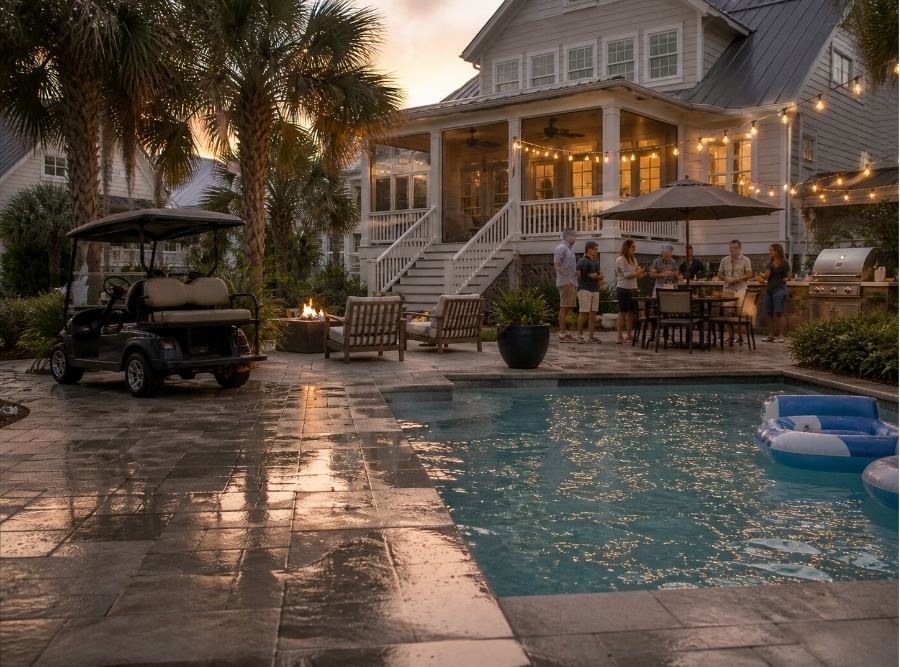
A neighbor’s guest slips near the pool during a weekend gathering in Bluffton. What starts as a simple accident turns into a serious injury claim with medical bills, legal involvement, and long-term consequences. The homeowner has insurance, but their liability limit is quickly exhausted, and the remaining costs don’t disappear, they become personal responsibility.
That’s the kind of situation most people don’t think about until someone asks a simple question: What would happen if a claim went beyond your current limits? Most homeowners in Bluffton don’t realize their liability coverage has a ceiling until something pushes past it.
What an Umbrella Policy Actually Does (and What It Doesn’t)
An umbrella policy is often described as “extra coverage,” but that doesn’t fully capture its role. At its core, it is excess liability protection that extends over your existing homeowners and auto insurance policies.
Your base policies each have liability limits, often in the range of $300,000 to $500,000. Those limits can feel substantial, but in a serious claim, they can be reached faster than expected. It’s not unusual for a major injury claim to exceed those limits once medical costs, lost income, and legal fees are involved.
An umbrella policy is designed to step in at that point. It does not replace your existing coverage, but instead adds another layer above it. This is why umbrella insurance exists, it extends your liability coverage beyond what homeowners and auto policies can handle on their own.
A simple way to think about it is this: your homeowners and auto policies are the foundation, and an umbrella policy is what protects everything above it.
Why Liability Risk Looks Different in Bluffton
Liability exposure in Bluffton is shaped by how people actually live, not just by what’s written in a policy. This is a place where outdoor living is part of everyday life, and where homes are often designed for gathering, hosting, and spending time outside.
In communities like Hampton Lake, Berkeley Hall, and Palmetto Bluff, it’s common to have guests over, use outdoor spaces frequently, and create environments where people are moving through the property. In areas like Sun City or along Buckwalter Parkway, golf cart use and shared community activity add another layer of exposure.
Even beyond the home, driving patterns play a role. Traffic along US-278, Bluffton Parkway, and I-95 increases the likelihood of more serious accidents, especially with congestion and speed transitions. A single accident involving multiple vehicles or injuries can escalate into a liability situation that quickly moves beyond standard limits.
What makes this important is not that these situations are unusual. It’s that they are part of normal life in Bluffton, and normal activity still carries real financial exposure when something goes wrong.
The Misconception: “This Is Only for Wealthy Homeowners”
One of the most common reasons people decline umbrella coverage is the belief that it’s only necessary for high-net-worth individuals. In practice, that distinction doesn’t hold up.
You don’t need to be exceptionally wealthy to face a claim that exceeds your base policy limits. Liability claims are driven by the severity of the situation, not by what feels reasonable or expected. Once legal action and long-term costs are involved, the numbers can grow quickly.
For many Bluffton homeowners, this becomes more relevant as life expands over time. A higher-value home, more time spent hosting, increased driving, or simply having more assets to protect than a few years ago can all increase exposure in ways that are easy to overlook.
The real question isn’t whether you’re “wealthy enough” to need an umbrella policy. It’s whether you have anything worth protecting.
Where Standard Coverage Starts to Break Down
Most homeowners feel comfortable with their current policies because nothing has gone wrong yet. The challenge is that liability exposure doesn’t reveal itself gradually. It becomes visible all at once when a claim pushes beyond your existing limits.
Common scenarios where this happens include serious guest injuries, major auto accidents, or situations involving multiple parties. In Bluffton, even something as routine as a golf cart incident in a neighborhood or a contractor injury on your property can escalate into a larger claim.
Once your base policy limit is reached, the remaining balance doesn’t disappear. Without additional coverage in place, that responsibility shifts directly to you. That can mean drawing from savings, assets, or future income to cover the difference.
The transition from “covered” to “personally exposed” happens faster than most people expect.
How Umbrella Coverage Fits Into a Complete Insurance Strategy
An umbrella policy works best when it is properly coordinated with your homeowners and auto coverage. There are minimum liability limits that typically need to be in place first, creating a solid base layer before the umbrella extends above it.
From there, the umbrella policy connects your different areas of exposure into one broader layer of protection. It aligns your coverage with how risk actually shows up across your home, your driving, and your day-to-day lifestyle.
This is where a more thoughtful, advisory approach makes a difference. Instead of simply adding more coverage, the goal is to make sure the structure of your protection reflects your real-world exposure.
As an independent agency, Coastal Haven Insurance is able to compare multiple carriers and adjust coverage as needed. That flexibility allows for a more complete approach, where policies are designed to work together rather than exist in isolation.
It’s Not About Expecting the Worst — It’s About Being Prepared for It
Umbrella policies are often evaluated based on probability. People ask what the chances are that they would ever need this kind of coverage. That question focuses on how often something happens, but not on what happens when it does.
Most claims fall within standard limits. The issue is the outlier, the situation that involves more people, more serious injuries, or longer-term consequences than expected. That’s where umbrella coverage becomes relevant.
In a place like Bluffton, where assets, activity, and exposure tend to grow over time, coverage should evolve alongside it. Liability risk rarely stays static, even if it feels that way.
The Gap Only Shows Up When It Matters Most
Liability exposure is one of the few areas in insurance where everything can feel adequate right up until the moment it isn’t. There’s no gradual warning and no clear signal that limits are too low. The gap only becomes visible when a claim pushes beyond it.
In Bluffton, where homes, lifestyles, and assets often grow over time, that gap can develop quietly in the background. Policies that once felt sufficient may no longer reflect the level of exposure that exists today.
If there’s any uncertainty around how your current liability limits compare to what you actually have at risk, it’s worth taking a closer look now. Because once a claim crosses that threshold, the question is no longer about coverage, it’s about what remains unprotected.

Coastal Haven Insurance Partners is an independent, locally owned insurance agency located in Bluffton, SC (40 Pennington Dr Suite E). Led by partners Coley Davis, Travers Davis, and William Voelkel, the firm brings over 30 years of combined insurance and leadership experience to the South Carolina Lowcountry. The team specializes in tailored homeowners, flood, windstorm, auto, and commercial insurance. They share straightforward guidance to help coastal residents and business owners protect their assets with confidence.