
What Is the Difference Between Golf Cart Insurance and Regular Car Insurance in South Carolina?
Quick Answer:
Golf cart insurance and regular car insurance are designed for different vehicles, different risks, and different legal requirements. While both can provide liability and physical damage protection, golf cart insurance is specifically built around how golf carts are used in South Carolina communities, including neighborhoods, golf cart paths, and certain public roads. Assuming your auto insurance or homeowners insurance automatically covers your golf cart can leave you with significant coverage gaps.
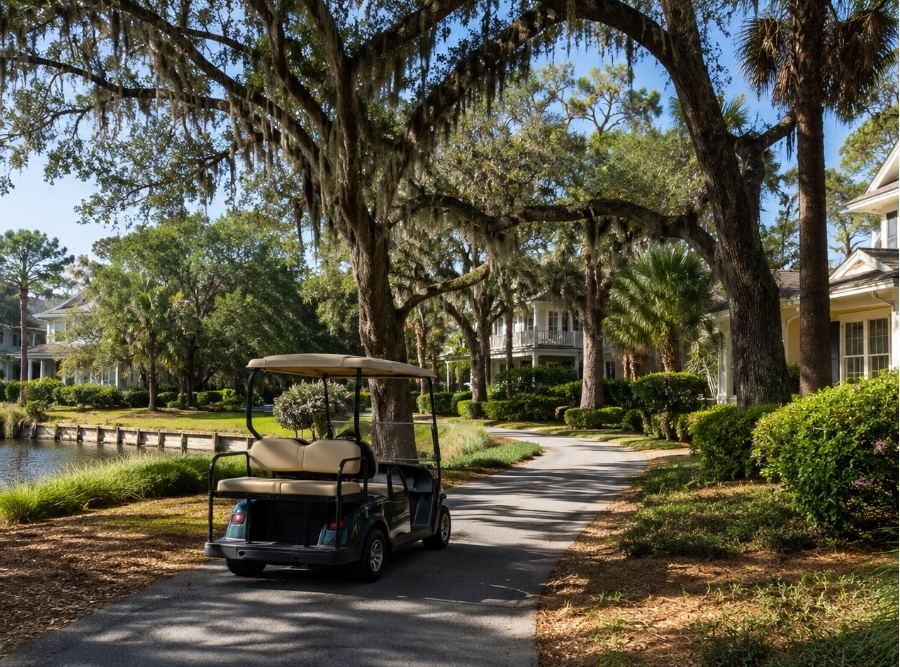
In many parts of the South Carolina Lowcountry, golf carts have become much more than recreational vehicles. Throughout Bluffton, Hilton Head Island, Sun City Hilton Head, and numerous golf course communities, golf carts are part of everyday life. Residents use them to visit neighbors, travel to community amenities, head to restaurants, attend social events, and navigate neighborhoods that were intentionally designed around golf cart transportation. For many families, the golf cart leaves the garage just as often as the family vehicle.
That convenience has created a growing number of questions about insurance. Many owners assume their existing auto insurance extends to the golf cart. Others believe their homeowners insurance provides all the protection they need. Some simply assume that because a golf cart is smaller and slower than a car, the risks must be smaller as well. Unfortunately, those assumptions are often where coverage problems begin.
Understanding the difference between golf cart insurance and regular auto insurance is important not only for protecting the cart itself but also for protecting yourself, your family, and your financial future if an accident occurs.
Why Golf Carts Are Insured Differently Than Cars
Although golf carts and automobiles are both used for transportation, insurance companies evaluate them very differently. A traditional automobile is built to operate in normal traffic environments and includes safety systems such as airbags, reinforced passenger compartments, advanced braking systems, and crash protection features. Golf carts were originally designed for use on golf courses and private property, where traffic conditions and operating speeds were significantly different.
Even though modern golf carts are commonly used throughout residential communities, they still present a unique risk profile. They often operate in areas shared by pedestrians, cyclists, children, pets, and other recreational users. They may cross public roads, travel through parking areas, or navigate community pathways where traditional traffic controls are limited.
Because the usage patterns are different, insurance carriers create specialized coverage designed around those unique exposures. The result is that golf cart insurance and auto insurance may look similar on the surface, but they are designed to solve very different problems.
Do Golf Carts Need Insurance in South Carolina?
One of the first questions many owners ask is whether insurance is actually required for a golf cart in South Carolina. The answer depends on how the golf cart is being used, where it is being operated, and whether it is registered for certain types of roadway use.
This is where many online articles oversimplify the issue. People often focus exclusively on whether insurance is legally required, when the more important question is whether operating without coverage creates financial risk. Those are two very different conversations.
We’ve spoken with homeowners who were primarily concerned about satisfying an HOA requirement or completing registration paperwork. While compliance matters, the bigger concern is what happens if an accident occurs and someone is injured. A golf cart owner may technically meet certain requirements and still discover they have very little protection when faced with medical bills, property damage claims, or legal expenses.
Insurance should not be viewed solely as a legal obligation. It should be viewed as protection against financial consequences that most families would prefer not to handle out of pocket.
The Homeowners Insurance Misconception That Creates the Most Problems
If there is one misunderstanding we encounter more than any other, it is the belief that homeowners insurance automatically covers golf cart accidents.
The confusion is understandable. After all, golf carts are often stored at home, used around the neighborhood, and associated with residential living. Many homeowners assume that because the cart is part of their household lifestyle, their homeowners policy must automatically provide protection.
The reality is far more complicated.
Coverage under a homeowners policy often depends on how the golf cart is being used and where the incident occurs. Certain situations may have limited protection, while others may fall entirely outside the policy’s intended coverage. What many owners fail to realize is that the moment a golf cart begins functioning as a transportation vehicle rather than simply recreational equipment, the insurance considerations often change.
Unfortunately, this misunderstanding is frequently discovered after an accident. We’ve seen situations where owners assumed they were protected because they had a homeowners policy, only to learn that their expectations and the actual policy language were not aligned.
That is why relying on assumptions can be far more expensive than reviewing coverage before a claim ever occurs.
What Golf Cart Insurance Actually Covers
Golf cart insurance is specifically designed to address the risks associated with owning and operating a golf cart. While coverage options vary by carrier, most policies are designed to address two primary concerns: protecting the owner from liability and protecting the golf cart itself.
Many owners initially focus on the value of the golf cart. However, the cart is often the smallest financial concern in a serious accident. The greater exposure usually comes from bodily injury claims, property damage claims, medical expenses, and potential legal costs that arise when another person is involved.
Dedicated golf cart coverage may help address situations involving injuries to passengers, damage to another person’s property, accidents involving pedestrians or cyclists, and physical damage to the cart itself. Depending on the policy, protection may also extend to events such as theft, vandalism, severe weather, and other covered losses.
The exact coverage available depends on the carrier and policy structure, which is why reviewing coverage details matters far more than simply assuming all golf cart policies are the same.
What Happens If Someone Gets Hurt?
This is where the conversation becomes significantly more important.
Many golf cart owners focus on whether the cart itself can be repaired after an accident. In reality, the more significant financial exposure often involves injuries. Imagine a scenario where a passenger falls from a moving golf cart, a cyclist is struck while crossing a pathway, or a pedestrian is injured during a neighborhood event. In those situations, the discussion quickly moves beyond the value of the golf cart.
Medical expenses can add up quickly. Legal costs can become substantial. Serious injuries may create long-term financial consequences that far exceed what most people initially imagine when they think about golf cart ownership.
This is one reason insurance professionals often encourage golf cart owners to think beyond the vehicle itself. The purpose of insurance is not simply to replace damaged property. It is to help protect individuals and families from financial situations that could otherwise become overwhelming.
Why Golf Cart Accidents Are Often More Serious Than People Expect
One of the biggest misconceptions surrounding golf carts is that lower speeds automatically mean lower risk.
The reality is that golf carts lack many of the safety systems found in passenger vehicles. Occupants often have less protection during sudden stops, collisions, or rollovers. Passengers may be seated in positions that make falls more likely. Pedestrians and cyclists frequently share the same operating environment, increasing the likelihood of injury when accidents occur.
We’ve seen many owners underestimate the severity of golf cart accidents because they compare them to automobiles. In truth, golf cart accidents often involve very different injury patterns because the vehicle itself provides less protection.
This becomes particularly important when children, teenagers, elderly passengers, or visitors are involved. A seemingly minor accident can produce consequences that are much more serious than the owner originally anticipated.
What We See Here in Bluffton and Hilton Head
The Lowcountry has a unique relationship with golf carts. In many parts of Hilton Head Island and Bluffton, golf carts are not occasional recreational vehicles. They are daily transportation.
Residents in communities such as Sea Pines, Palmetto Dunes, Hilton Head Plantation, Wexford, Indigo Run, Sun City Hilton Head, and many Bluffton neighborhoods use golf carts to navigate their communities every day. They travel to golf courses, marinas, community centers, pools, restaurants, and social gatherings. In some neighborhoods, golf carts are simply part of the local culture.
What we frequently see is that usage evolves over time. A golf cart that was originally purchased for weekend recreation gradually becomes part of a family’s everyday routine. Children begin riding in it more frequently. Guests use it when visiting. Trips become longer and more frequent. Road crossings become routine. Yet the insurance coverage often remains exactly as it was when the cart was first purchased.
The risk changes, but the policy never changes with it.
That is where many coverage gaps begin.
How Golf Cart Risks Change Over Time
One of the most overlooked aspects of golf cart ownership is that usage patterns rarely stay the same.
Many owners begin with limited recreational use. The cart is driven occasionally around the neighborhood or taken to the golf course. Over time, convenience encourages more frequent use. The golf cart becomes the preferred way to visit neighbors, attend community events, run errands within the neighborhood, or transport family members to local amenities.
Eventually, many owners find themselves using the cart in ways they never anticipated when they first purchased it.
Insurance should evolve alongside those changes. A policy that made sense when the golf cart was driven twice a month may not be appropriate once it becomes part of daily transportation. Regular reviews help ensure coverage continues to match reality rather than assumptions.
Why Independent Guidance Matters for Golf Cart Owners
Golf cart ownership is becoming increasingly common throughout the South Carolina Lowcountry, but no two owners use their carts in exactly the same way. Some use them occasionally. Others rely on them almost daily. Some remain entirely within private communities, while others routinely cross public roads or navigate mixed-use areas.
As an independent insurance agency in Bluffton, Coastal Haven Insurance works with multiple insurance carriers rather than a single company. That flexibility allows us to help clients compare options, evaluate coverage differences, and find solutions that align with how their golf carts are actually used.
More importantly, we believe insurance works best when it is reviewed before a claim occurs. A simple conversation today can often prevent a frustrating surprise tomorrow.
The Real Cost of Assuming You’re Covered
The biggest mistake most golf cart owners make is not purchasing the wrong policy. It’s assuming they already have the right one.
Golf carts have become an everyday part of life throughout Bluffton, Hilton Head Island, and many Lowcountry communities. As their role continues to expand beyond recreation and into daily transportation, insurance decisions deserve the same level of attention most people give their automobiles.
The difference between golf cart insurance and regular car insurance is not simply a matter of vehicle type. It is a matter of understanding how risks, liability, and coverage apply to the way you actually live. Before the next neighborhood trip, community event, or family outing, it’s worth taking the time to make sure your protection matches the reality of how your golf cart is being used today.
To review your golf cart coverage, contact Coastal Haven Insurance or call (843) 507-5072.