Does Homeowners Insurance Cover Storm Surge Damage in Bluffton, SC?
Quick Answer:
No, homeowners insurance does not cover storm surge damage in Bluffton, SC. Storm surge is classified as flood damage, which is excluded from standard homeowners policies. To be protected, you need a separate flood insurance policy.
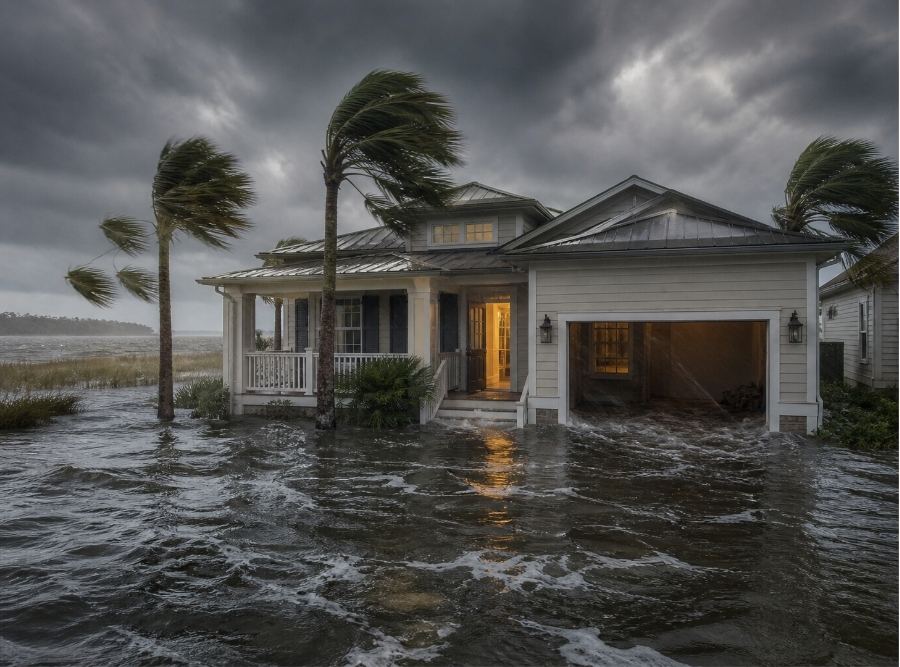
A hurricane pushes water off the May River and into a neighborhood in Bluffton. It comes through the garage first, then the doors, then across the floors. By the time the storm passes, the home is unrecognizable inside. The homeowner files a claim thinking this was hurricane damage and should be covered, only to find out the loss is denied due to flood.
That moment catches a lot of Lowcountry homeowners off guard. In Bluffton and across coastal South Carolina, storm surge is almost always treated as flood damage, not standard homeowners insurance coverage. Understanding that distinction before a storm hits is one of the most important parts of getting your coverage right.
Storm Surge vs. Storm Damage: Why the Difference Matters in Bluffton
One of the most common assumptions we hear is that if a hurricane causes the damage, it should all fall under homeowners insurance. That feels logical, but insurance does not work that way. What matters is not the storm itself, but how the damage occurs and how water enters the home.
Storm surge is defined as rising water pushed inland by a hurricane or tropical system. From an insurance standpoint, that is classified as flood, even though it is tied directly to a storm. That definition is what separates it from other types of storm damage and determines how a claim is handled.
This distinction carries more weight in Bluffton than in many inland areas. With the May River, tidal marshes, and low-lying terrain throughout communities like Old Town, Hampton Lake, and parts of New Riverside, water does not need to behave like a traditional river flood to cause serious damage. It can follow tidal patterns, combine with heavy rainfall, and reach homes that are not typically thought of as high-risk.
Most homeowners only learn how this distinction works when they are already in the middle of a claim.
Why Homeowners Insurance Does Not Cover Storm Surge
Standard homeowners insurance policies include a flood exclusion, and that exclusion applies to any form of rising water entering the home from outside. That includes storm surge, tidal overflow, and water coming in at ground level through doors, foundations, or garages.
The key factor is not the presence of a storm, but the direction and source of the water. If water rises from the ground and moves inward, it is treated as flood damage. That places it outside the scope of a homeowners policy, regardless of how severe the storm was.
This is where real-world claims often become complicated. In Bluffton, it is common for a single storm to cause multiple types of damage at once. A roof may be damaged by wind, allowing rain to enter from above, while storm surge enters at ground level at the same time. From the homeowner’s perspective, it is one event. From an insurance standpoint, it is evaluated as separate causes of loss.
That split is what leads to partial coverage, confusion, and in many cases, unexpected financial exposure.
The Cost of Getting This Wrong in the Lowcountry
This is not a small technical detail. In Bluffton, Hilton Head Island, and surrounding areas, storm surge can lead to extensive interior damage within hours. Floors, drywall, electrical systems, cabinetry, and personal property at ground level are often affected all at once.
Without flood insurance in place, those losses are typically not covered. That can leave homeowners facing significant out-of-pocket costs, extended rebuild timelines, and difficult financial decisions after an already stressful event. In more severe cases, it can mean a total loss without the coverage needed to rebuild.
We have seen homeowners who were responsible in every other way. They had insurance, maintained their home, and believed they were properly protected. The gap came from one misunderstanding: assuming that hurricane-related water damage would be covered under their homeowners policy.
In a coastal environment like the Lowcountry, that assumption can be costly.
“I’m Not in a Flood Zone” — A Common Bluffton Misconception
Another pattern that comes up often is relying on flood zone designations or lender requirements as the deciding factor for flood insurance. While those guidelines are useful, they do not always reflect how water actually behaves during a storm in coastal South Carolina.
Bluffton’s geography includes tidal systems, marshland, and subtle elevation changes that influence how water moves. Areas that are not considered high-risk on a map can still experience flooding, especially when storm surge combines with heavy rainfall and saturated ground conditions.
Neighborhoods along Buckwalter Parkway, parts of Bluffton Park, and even newer developments further inland are not immune to this. Flood risk in the Lowcountry extends beyond mapped zones and does not always follow predictable boundaries.
Relying only on whether flood insurance is required can create a false sense of security.
What Actually Covers Storm Surge Damage
Storm surge damage is covered under a flood insurance policy, not a standard homeowners policy. These policies are designed specifically for rising water events, including tidal flooding and surge from hurricanes.
Flood insurance is typically available through the National Flood Insurance Program or private carriers. It works alongside your homeowners policy so that different types of damage are handled appropriately based on how they occur.
The goal is to have a coordinated structure where wind-related damage is covered under your homeowners policy and flood-related damage is covered under your flood policy. Without both pieces in place, gaps can exist that only become visible after a storm.
A More Complete Approach to Coverage in Bluffton and the Lowcountry
Insurance along the coast requires a more thoughtful approach than simply putting a policy in place and leaving it unchanged. In Bluffton, coverage needs to reflect how your specific property would respond during a storm, not just what is required or commonly assumed.
That usually means taking the time to look at elevation, proximity to marsh or water, construction details, and how different policies interact with each other. It also means revisiting coverage over time as conditions, property values, and insurance markets change.
As an independent agency, Coastal Haven Insurance is able to compare multiple carriers and adjust coverage when needed. That flexibility allows for a more advisory approach, where the focus is on making sure your protection holds up in a real-world scenario, not just on paper.
The Storm Isn’t the Problem — The Coverage Gap Is
In Bluffton, storm surge isn’t rare, and it’s not unpredictable. What tends to catch homeowners off guard isn’t the water itself, but how their insurance policy responds once it reaches the home. The damage feels like one event, but the coverage is divided in ways most people never fully see until it is too late.
The real question isn’t whether you have insurance. It is whether your coverage actually matches how water would reach your home during a storm. In a place shaped by marshes, tidal movement, and coastal weather patterns, that distinction matters more than most people expect. Policies that look solid on paper can still leave gaps when real-world conditions come into play.
If there is any uncertainty around how your current coverage handles storm surge or flood-related damage, it is worth walking through it now, before a storm forces the question. Because when it comes down to it, most storm claims are not decided by the storm itself. They are decided by where the water came from.
Coastal Haven Insurance Partners is an independent, locally owned insurance agency located in Bluffton, SC (40 Pennington Dr Suite E). Led by partners Coley Davis, Travers Davis, and William Voelkel, the firm brings over 30 years of combined insurance and leadership experience to the South Carolina Lowcountry. The team specializes in tailored homeowners, flood, windstorm, auto, and commercial insurance. They share straightforward guidance to help coastal residents and business owners protect their assets with confidence.