
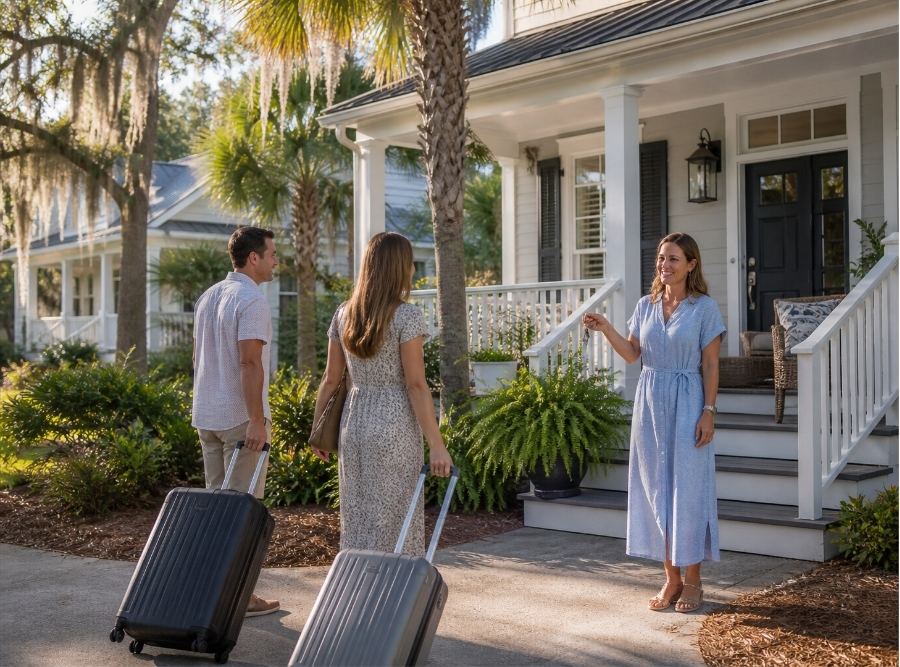
What Happens to My Home Insurance If I Rent Out My Bluffton House on Airbnb?
Quick Answer:
In most cases, your standard homeowners insurance in Bluffton will not fully cover short-term rentals like Airbnb. Renting your home even occasionally can trigger business-use exclusions, meaning damage or liability claims involving guests may not be covered. To be properly protected, you typically need a home-sharing endorsement, landlord-style policy, or specialized short-term rental insurance.
A lot of homeowners in Bluffton don’t think of Airbnb as a major change. It starts as something simple—renting the house for a few weekends, maybe during peak Hilton Head travel season, or using it to offset costs when you’re out of town.
From your perspective, it’s still your home. But from an insurance standpoint, that one decision changes how the property is classified entirely. The part most people don’t realize is that if something goes wrong, a guest injury or significant damage, your homeowners policy may not respond the way you expect, even if you’ve had the policy for years.
Why Airbnb Changes Your Insurance More Than You Expect
Homeowners insurance is built around personal use. It assumes you, your family, and your guests are using the home without any financial transaction involved. The moment money enters the picture when someone pays to stay there, the risk profile shifts.
Insurance companies view that as business activity, not personal use.
That distinction matters because most standard homeowners policies include a business-use exclusion. This means that once your home is used for short-term rentals, certain protections you assumed were in place may no longer apply in the same way.
This is where many homeowners in Bluffton get caught off guard. The home hasn’t changed physically, but the way it’s being used hasband that changes how coverage responds.
The Biggest Misconception: “It’s Occasional, So It’s Fine”
One of the most common assumptions is that renting your home “once in a while” doesn’t really count. Maybe it’s just during the Heritage tournament, a few summer weeks, or when friends recommend trying Airbnb.
From an insurance perspective, frequency doesn’t necessarily change the classification.
Even occasional rentals can fall under business use, which can trigger exclusions in your policy. The issue is not how often you rent, it’s that you are renting at all.
We’ve had homeowners tell us, “I’m only doing it a few times a year,” assuming that keeps them within normal coverage. In reality, that’s often enough to create a gap if something goes wrong.
What Actually Happens If You Don’t Update Your Policy
This is where things become serious, because the gap doesn’t show up until a claim is filed.
If a guest damages your home, your homeowners policy may limit or deny coverage depending on how the loss is classified. If a guest is injured—slips on a wet patio, falls on stairs, or is hurt using your property, your personal liability coverage may not apply the way you expect.
We’ve seen situations where a guest slipped on a wet patio after a summer storm and required medical attention. The homeowner assumed their liability coverage would apply, but because the stay was considered a rental, the policy responded differently than expected. That’s the type of scenario that turns a small incident into a much larger financial issue.
In Bluffton, where many homes are higher value and located in communities like Hampton Lake, Palmetto Bluff, or along the Buckwalter corridor, the severity of those claims can escalate quickly. It’s not just about replacing damaged furniture, it can involve structural damage, liability claims, or legal costs.
Why Airbnb’s Coverage Is Not a Replacement for Insurance
Many homeowners rely on Airbnb’s host protection or “guarantee” programs, assuming that fills the gap. While those programs can provide some level of protection, they are not designed to replace a comprehensive insurance policy.
Airbnb’s protections are designed as a secondary layer, not a primary insurance solution. They may help in certain situations, but they are not structured to replace a policy that is built specifically for short-term rental risk.
They come with limitations, exclusions, and conditions that are very different from a traditional insurance contract. Coverage may not apply in all situations, payouts may not align with actual repair costs, and liability protection may not extend as broadly as homeowners expect.
This is where short-term rental insurance in South Carolina and proper Airbnb liability coverage in SC become essential, depending on how frequently the home is rented.
How Bluffton’s Market Makes This More Important
Short-term rentals in Bluffton are not the same as in other parts of South Carolina. The proximity to Hilton Head, seasonal tourism, and demand for short stays all increase usage and turnover.
In Bluffton, where short-term rental demand is tied closely to Hilton Head overflow and seasonal travel, homes often see higher guest turnover than expected. That increased frequency changes both wear-and-tear and liability exposure more quickly than many homeowners anticipate.
Add in the realities of the Lowcountry—humidity, storm exposure, and material wear and the risk profile increases even further.
What makes this tricky is that everything can appear to be working fine for months or even years. Guests come and go, nothing major happens, and it reinforces the belief that the setup is fine. The risk builds quietly in the background until something forces a closer look.
What Proper Coverage Looks Like for Airbnb in Bluffton
When a home is used as a short-term rental, the insurance needs to reflect that usage. There isn’t a one-size-fits-all solution, but the structure typically changes in one of several ways.
Some homeowners can add a home-sharing endorsement that modifies their existing policy. Others may need to move to a landlord-style policy or a hybrid policy designed specifically for short-term rental activity. In some cases, especially with frequent rentals or higher income, the home may be treated more like a business exposure.
The key is that liability coverage must extend to paying guests, and property coverage must reflect the increased risk associated with short-term occupancy.
The Real Risk: Not the Rental, But the Assumption
The biggest issue is not Airbnb itself, it’s assuming your existing insurance already covers it.
We’ve seen situations where homeowners listed their property, had successful rentals for months, and assumed everything was fine because nothing had gone wrong. The exposure builds quietly in the background until something forces the question.
At that point, it’s not about adjusting coverage, it’s about dealing with a claim that may not be covered the way it should be.
Why This Is Worth Addressing Before You List Your Home
This is one of those decisions where timing matters more than people expect. It’s much easier to structure coverage correctly before the first guest arrives than it is to fix things after a claim or after an insurance company flags the activity.
In some cases, undisclosed rental activity can lead to policy non-renewal or cancellation once discovered. That can make it harder to find coverage later, especially in a coastal market like Bluffton where underwriting is already more selective.
The difference is whether you’re setting this up proactively or reacting after something triggers a review.
What Happens When Your Coverage Matches How You Use the Home
When your policy is aligned with how the home is actually being used, the uncertainty disappears. You know how property damage will be handled. You know how liability applies to guests. And you’re not relying on assumptions or partial protections.
For many homeowners, that clarity is just as important as the coverage itself. The goal isn’t to complicate the process, it’s to make sure you’re not taking on exposure you didn’t realize was there.
If you’re considering renting your Bluffton home on Airbnb or already have, it’s worth taking a closer look at how your current policy handles that exposure. The difference between assuming it works and knowing it’s properly set up is where the real protection comes from.

Coastal Haven Insurance Partners is an independent, locally owned insurance agency located in Bluffton, SC (40 Pennington Dr Suite E). Led by partners Coley Davis, Travers Davis, and William Voelkel, the firm brings over 30 years of combined insurance and leadership experience to the South Carolina Lowcountry. The team specializes in tailored homeowners, flood, windstorm, auto, and commercial insurance. They share straightforward guidance to help coastal residents and business owners protect their assets with confidence.