
What Is the Minimum Car Insurance Required in South Carolina?
Quick Answer:
South Carolina requires drivers to carry minimum liability insurance of 25/50/25, which means $25,000 for bodily injury per person, $50,000 per accident, and $25,000 for property damage. The state also requires uninsured motorist coverage at the same limits. This is the legal minimum to drive but it does not cover damage to your own vehicle or fully protect you in most real-world accidents.
Someone calls and says, “I just need whatever the state requires.” It usually comes down to keeping the monthly payment as low as possible while staying legal.
That’s a reasonable place to start but it’s also where a lot of people misunderstand what minimum coverage actually does, especially here in South Carolina. The gap between what’s required by law and what actually protects you can be much larger than most drivers expect.
What South Carolina Actually Requires (And What It Includes)
South Carolina follows a financial responsibility system, which means drivers must carry a minimum level of liability insurance to legally operate a vehicle. Those limits, commonly referred to as 25/50/25 are structured to cover injuries and damages you cause to others in an accident.
The $25,000 bodily injury limit applies to each person injured in an accident, while the $50,000 limit is the maximum the policy will pay for all injuries in a single accident. The $25,000 property damage limit applies to damage you cause to someone else’s vehicle or property. In addition to liability, the state requires uninsured motorist coverage at the same limits, which protects you if you’re hit by a driver who has no insurance.
What’s important to understand is what this does not include. Minimum coverage does not pay for damage to your own vehicle, does not include protection for theft, weather, or falling debris, and does not extend beyond those fixed liability limits if costs exceed them.
What 25/50/25 Looks Like in a Real Bluffton Accident
On paper, those numbers can sound reasonable. In practice, they often fall short faster than people expect.
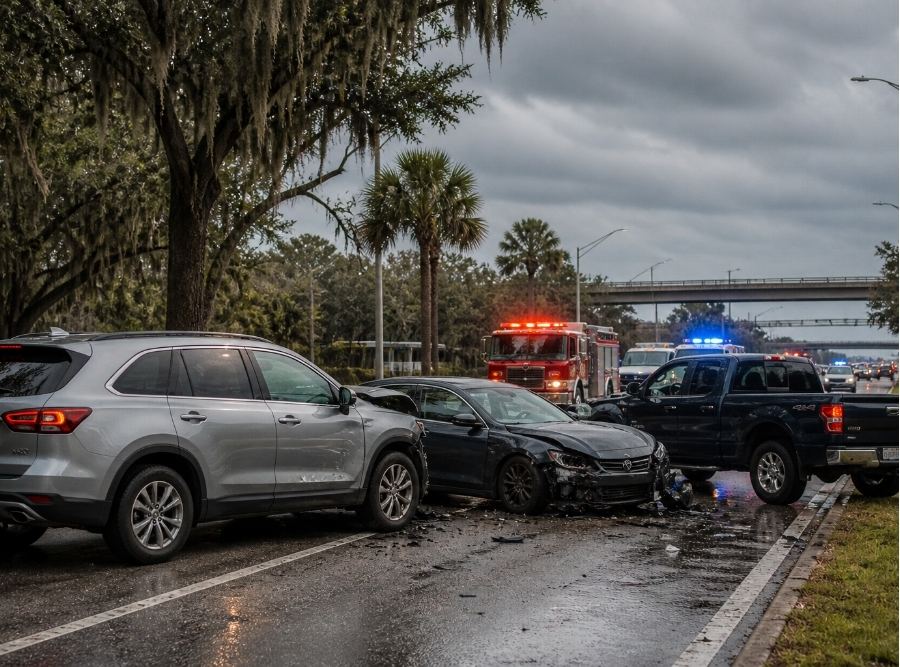
Imagine a multi-vehicle accident on US-278 heading toward the Hilton Head bridge during heavy traffic. One newer SUV, one pickup, and a sedan are involved. Repair costs alone for a newer SUV can approach or exceed $25,000 depending on the damage. If multiple vehicles are involved, that $25,000 property damage limit gets used quickly.
Now factor in injuries. Even a moderate accident can lead to emergency room visits, follow-up care, and lost wages. It doesn’t take a severe situation for medical costs to exceed $25,000 per person. If more than one person is injured, that $50,000 total limit for the entire accident can be exhausted very quickly.
At that point, the insurance policy doesn’t expand, it stops. Anything beyond those limits becomes the driver’s responsibility.
Why “Legal Minimum” and “Enough Coverage” Are Not the Same
This is the distinction that matters most. The state sets minimum requirements so you can legally drive, not so you are financially protected in a real-world accident.
Vehicle values are higher than they used to be, and repair costs have increased with modern technology. Medical expenses continue to rise as well. The minimum limits have not kept pace with those changes, which is why they often fall short when a claim actually happens.
In areas like Bluffton and Hilton Head, where newer vehicles and multi-car households are common, that gap becomes even more noticeable. You are more likely to be sharing the road with vehicles that cost significantly more to repair or replace, which increases the likelihood that minimum limits will not be enough.
Is Minimum Car Insurance Enough in South Carolina?
In most real-world situations, minimum car insurance is not enough to fully protect you. It meets the legal requirement, but it leaves gaps in both liability protection and coverage for your own vehicle. A single accident involving injuries or multiple vehicles can exceed those limits quickly, especially in higher-cost areas like the Lowcountry.
The real question is not whether minimum coverage is allowed, it’s whether it would hold up if something actually happened.
The Trade-Off Most People Don’t Fully See
Choosing minimum coverage usually starts with a focus on lowering the monthly payment. On the surface, it works, you’ll typically see a lower premium compared to higher coverage options. The part that often gets overlooked is what you’re giving up in exchange for that savings.
Insurance does not automatically cover all damages after an accident. It only pays up to the limits you’ve selected. If those limits are too low, the remaining costs don’t disappear, they shift to you.
There is also no coverage for your own vehicle under a minimum policy. If your car is damaged in an accident, or affected by something like flooding or storm debris, those costs come out of pocket unless you’ve added collision or comprehensive coverage.
When Minimum Coverage Might Make Sense—and Its Limits
There are situations where minimum coverage may be a reasonable short-term decision. For example, if you are driving an older vehicle with very low value, or if you are in a temporary financial situation where keeping costs down is critical, minimum coverage may serve a purpose.
However, even in those cases, it’s important to understand the trade-offs clearly. You are accepting a higher level of financial risk in exchange for a lower monthly payment. That decision should be intentional, not based on the assumption that minimum coverage is “enough.”
As your situation changes whether that’s a newer vehicle, increased income, or more assets to protect those limits should be revisited.
Why This Matters More in Bluffton and the Lowcountry
Location plays a significant role in how these decisions play out. Bluffton continues to grow rapidly, and with that growth comes increased traffic and more complex accident scenarios. Roads like Bluffton Parkway and US-278 regularly see congestion and multi-vehicle incidents, especially during peak travel times and tourist seasons.
Add in coastal weather conditions like heavy rain and storm activity, and the overall risk environment becomes more demanding than what minimum coverage was designed for. These aren’t rare scenarios, they’re part of everyday life in the Lowcountry, and insurance coverage should reflect that reality.
The Advantage of Going Beyond the Minimum
This is where working with an independent agency can make a meaningful difference. Instead of defaulting to the lowest legal option, the goal is to align your coverage with your actual exposure.
In many cases, increasing liability limits from the state minimum to more appropriate levels costs far less per month than people expect. That small adjustment can significantly reduce your financial risk in the event of an accident. Adding options like underinsured motorist coverage can also provide an additional layer of protection, especially given how many drivers carry only minimum limits.
More importantly, this isn’t a one-time decision. Insurance should evolve as your life changes. Most people only revisit their policy after a problem arises, but a more proactive approach helps prevent those gaps from developing in the first place.
The Real Question Isn’t What’s Required—It’s What Happens After
Minimum car insurance in South Carolina is designed to keep you legal, not necessarily protected. Understanding that difference is what allows you to make better decisions about your coverage.
If you’re not sure what your current limits are, if your policy hasn’t been reviewed in a few years, or if you’ve been focused solely on keeping your payment low, it may be time to take a closer look. The goal isn’t to spend more, it’s to make sure what you have actually works if you need it.
At Coastal Haven Insurance, we take the time to walk through your coverage, explain what it means in real terms, and compare options across multiple carriers. That way, you can make a decision based on clarity, not assumptions about what minimum coverage really provides and where it may fall short.

Coastal Haven Insurance Partners is an independent, locally owned insurance agency located in Bluffton, SC (40 Pennington Dr Suite E). Led by partners Coley Davis, Travers Davis, and William Voelkel, the firm brings over 30 years of combined insurance and leadership experience to the South Carolina Lowcountry. The team specializes in tailored homeowners, flood, windstorm, auto, and commercial insurance. They share straightforward guidance to help coastal residents and business owners protect their assets with confidence.