
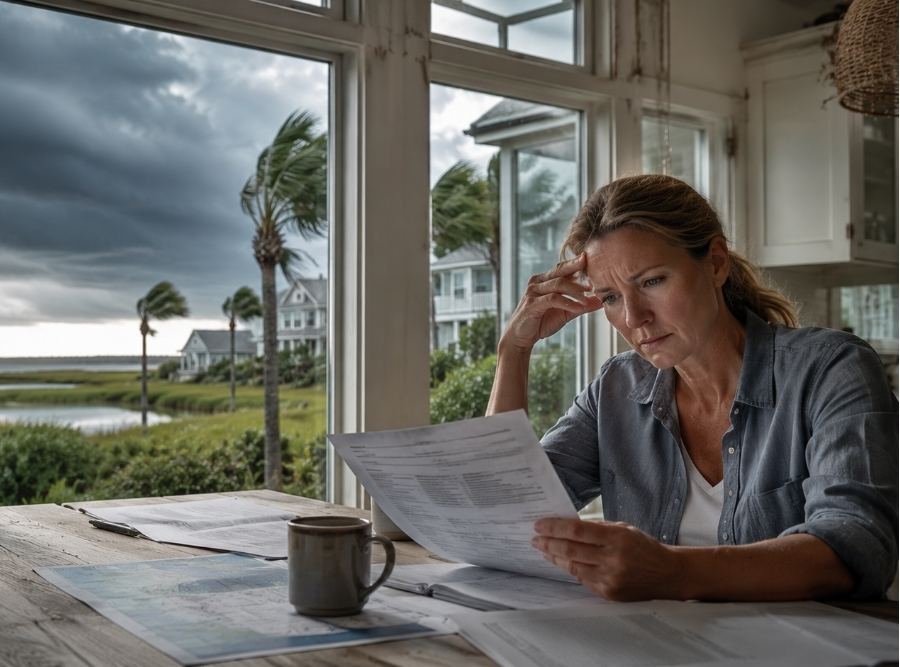
What Is a Hurricane Deductible in South Carolina and How Does It Work for Hilton Head Homeowners?
Quick Answer:
A hurricane deductible in South Carolina is a separate deductible that usually applies to wind damage caused by a named storm or hurricane. Instead of a flat dollar amount like $1,000, it is often calculated as a percentage of your home’s insured value, which means a 2% deductible on a $500,000 home would equal $10,000 before insurance begins paying for covered hurricane damage.
A lot of Hilton Head homeowners do not realize how their hurricane deductible actually works until after a storm claim happens. They may know they have homeowners insurance and understand their monthly premium, but the deductible structure itself often goes unnoticed for years. Then a tropical storm or hurricane damages the roof, a claim is filed, and suddenly the homeowner discovers the deductible is far larger than expected.
We regularly hear some version of the same reaction across Hilton Head, Bluffton, Beaufort, and other coastal South Carolina communities. Homeowners say they thought their deductible was only $1,000 or $2,500. Others assume the percentage applies only to the repair cost rather than the insured value of the house. Some discover for the first time that their policy has multiple deductibles depending on what caused the damage.
The confusion is understandable because coastal homeowners policies in South Carolina can become much more complicated than standard inland coverage. Hurricane deductibles, named storm deductibles, wind and hail deductibles, flood exclusions, and percentage-based structures all interact differently depending on the policy language and the type of storm damage involved.
Why Hurricane Deductibles Exist in Coastal South Carolina
Insurance companies view coastal South Carolina very differently than inland areas of the state. Homes throughout Hilton Head Island, Pawleys Island, Charleston, Beaufort, Myrtle Beach, and other coastal communities face significantly higher exposure to hurricanes, tropical storms, wind-driven rain, roof uplift damage, falling trees, and widespread catastrophic losses.
Because of that elevated exposure, many carriers structure coastal policies differently in order to manage hurricane risk financially. One of the main ways they do that is through percentage-based hurricane deductibles rather than flat deductibles.
This is why homeowners along the coast often see deductibles listed as 1%, 2%, 3%, or even 5% on their declarations page. The higher the coastal exposure, the more likely the policy is to include a larger wind or hurricane deductible structure.
From the insurance company’s perspective, these deductibles help share some of the financial risk associated with catastrophic storm losses. From the homeowner’s perspective, the deductible can feel surprisingly large after a storm if they did not fully understand how it was calculated beforehand.
That misunderstanding is extremely common in Hilton Head because many homeowners focus primarily on the premium while overlooking the deductible structure entirely. A policy with a lower premium can sometimes shift far more financial responsibility onto the homeowner after a hurricane claim occurs.
Why Percentage Deductibles Shock So Many Homeowners
One of the biggest misunderstandings surrounding hurricane deductibles is how the percentage is actually calculated. Many homeowners assume the percentage applies to the repair estimate itself. In reality, the deductible is usually based on the insured value of the home, not the size of the claim.
For example, a homeowner with a $750,000 dwelling coverage limit and a 2% hurricane deductible would typically be responsible for the first $15,000 of covered hurricane damage before insurance begins paying. That number surprises many people because the deductible feels manageable when written as “2%” but becomes much more significant when converted into actual dollars.
This becomes especially important in Hilton Head because coastal property values and rebuild costs are often substantially higher than inland South Carolina homes. Luxury homes in Sea Pines, Wexford, Palmetto Dunes, or Port Royal may carry very large insured values due to custom finishes, elevated construction requirements, architectural standards, and coastal rebuilding costs. Even a relatively modest percentage deductible can create a substantial out-of-pocket expense after a storm.
We also see confusion when homeowners compare policies based only on premium pricing. A cheaper quote may look attractive initially, but the savings sometimes come with significantly higher hurricane deductibles or more restrictive wind coverage structures. Many homeowners do not fully realize the tradeoff until they review the deductible more carefully or experience a storm claim firsthand.
The Difference Between Your Regular Deductible and Hurricane Deductible
Another major source of confusion is the existence of multiple deductibles within the same homeowners policy. Many South Carolina coastal policies include an “all-other-perils” deductible alongside a separate hurricane or wind/hail deductible.
The all-other-perils deductible is typically the standard deductible homeowners are familiar with for things like smaller water losses, theft claims, or certain non-hurricane-related damage. The hurricane deductible usually applies only under specific storm-related circumstances defined in the policy language.
This is where terms like “named storm deductible” or “wind/hail deductible” begin appearing. Some policies apply the higher deductible only when the National Weather Service officially names a tropical storm or hurricane. Others may use broader windstorm language depending on the carrier and policy structure.
Many homeowners do not realize which deductible applies until after damage occurs. They assume all storm damage falls under the same deductible structure when in reality the triggering language inside the policy may determine which deductible applies.
This becomes especially important after hurricanes in Hilton Head because wind damage and flood damage are also handled separately. Homeowners insurance generally covers certain types of wind damage while flood damage is usually handled under a separate flood insurance policy entirely. Many homeowners mistakenly assume all hurricane-related damage falls under one combined claim structure when it often does not.
Why Hilton Head Homeowners Need to Understand This Before Hurricane Season
One of the biggest problems with hurricane deductibles is that homeowners often review them too late. After a storm approaches, contractor demand surges, repair costs increase, and stress levels rise quickly. That is not the ideal time to discover the deductible is far larger than expected.
We regularly see homeowners throughout Hilton Head and Bluffton who know they have hurricane coverage but have never converted the percentage deductible into actual dollar terms. Once they finally see the number clearly, the financial exposure becomes much more real.
That matters because deductible planning is not just an insurance conversation. It is also a financial preparedness conversation. Homeowners should realistically understand whether they could comfortably absorb the deductible after a storm while still managing temporary repairs, emergency mitigation, evacuation costs, or delays in contractor availability.
This becomes especially important for second homes, retirement properties, and vacation homes throughout Hilton Head Island where absentee ownership sometimes delays claim response or repair coordination after storms. Out-of-state owners often discover policy details late because they rely heavily on property managers, mailed renewals, or escrow handling without fully reviewing the deductible structure themselves.
Homes located closer to marshes, oceanfront areas, or heavily exposed wind corridors may also face more restrictive deductible options depending on carrier appetite and underwriting conditions.
Why Roof Claims Often Create Deductible Confusion
One of the most frustrating situations homeowners experience happens when roof damage occurs but the repair estimate falls below the hurricane deductible. In those situations, homeowners sometimes believe the claim was denied when technically the damage may have been covered but did not exceed the deductible threshold.
This happens frequently after tropical storms or lower-level hurricanes where roof damage is real but not catastrophic enough to surpass a large percentage deductible. The homeowner may still face significant repair costs while receiving little or no claim payment because the deductible absorbs most or all of the covered loss.
That misunderstanding can create dangerous delays. Some homeowners postpone repairs because they expected insurance to cover the damage more aggressively. Meanwhile, small roof openings or storm-related vulnerabilities allow moisture intrusion to worsen over time, eventually leading to interior water damage, mold growth, or structural deterioration that becomes far more expensive later.
We often tell homeowners that understanding the deductible before a storm happens helps create much more realistic expectations afterward. The goal is not simply knowing whether wind damage is covered. The goal is understanding what portion of the financial responsibility still belongs to the homeowner after the deductible applies.
Why Two Neighboring Homes May Have Different Hurricane Deductibles
Another common question we hear in Hilton Head involves neighbors comparing policies and discovering very different deductible structures. Homeowners are often surprised when two nearby houses have completely different hurricane deductibles despite being in the same community.
Several factors influence that difference. Carrier selection, home value, roof age, construction characteristics, prior claims history, policy form, wind exposure, elevation, and underwriting appetite all affect available deductible options. Homes closer to direct ocean exposure or marshfront wind corridors may face different underwriting treatment than more protected inland properties.
The age of the home and the quality of wind mitigation features also matter significantly. Newer construction in Bluffton or newer sections of Hilton Head may sometimes qualify for different underwriting structures than older coastal homes in Sea Pines, Forest Beach, or Port Royal where wind exposure and rebuilding complexity create greater insurer concern.
This is why comparing policies based only on premium pricing rarely tells the full story. Two homeowners may pay somewhat similar premiums while carrying very different levels of out-of-pocket storm exposure.
The Goal Is Not Just Lower Premiums — It Is Understanding Your Real Storm Exposure
One of the biggest mistakes homeowners make is focusing almost entirely on premium while paying very little attention to deductible structure. In coastal South Carolina, those two things are deeply connected.
Lower premiums often come with higher deductibles, especially for wind and hurricane exposure. That does not automatically mean a higher deductible is wrong. Some homeowners intentionally choose higher deductibles because they have the financial reserves to absorb larger out-of-pocket costs after a storm. Others prefer paying higher premiums in exchange for lower storm deductibles and more predictable financial exposure.
The important thing is understanding the tradeoff clearly before hurricane season arrives.
Many homeowners feel blindsided after storms not because the deductible was hidden, but because nobody slowed down enough to explain what the percentage actually meant in real-world dollar terms. A hurricane deductible may look small on paper until it becomes attached to a high-value coastal property in Hilton Head Island.
That is why reviewing hurricane deductibles proactively matters so much for coastal homeowners. The conversation should involve not only the premium, but also how much financial responsibility the homeowner could realistically face after a named storm, tropical system, or major wind event.
Understanding the Numbers Before the Storm Is Usually Less Stressful Than Learning Them After
Hurricane deductibles are one of the most misunderstood parts of homeowners insurance in South Carolina, especially throughout Hilton Head and the surrounding Lowcountry. Many homeowners carry percentage deductibles for years without fully understanding how large the out-of-pocket exposure could become after a serious storm.
The goal is not creating fear around hurricane coverage. Coastal homeowners absolutely need strong wind protection. The goal is understanding how the deductible structure actually works before a claim happens so there are fewer surprises during an already stressful situation.
For homeowners in Hilton Head, Bluffton, Beaufort, and other coastal South Carolina communities, reviewing hurricane deductibles before storm season can help create much clearer expectations about what insurance may pay, what flood coverage does separately, and what financial responsibility may still remain after wind damage occurs.
Coastal Haven Insurance can help homeowners review their current deductible structure, explain how named storm and wind deductibles function, and help compare options based on both premium and realistic out-of-pocket storm exposure.

Coastal Haven Insurance Partners is an independent, locally owned insurance agency located in Bluffton, SC (40 Pennington Dr Suite E). Led by partners Coley Davis, Travers Davis, and William Voelkel, the firm brings over 30 years of combined insurance and leadership experience to the South Carolina Lowcountry. The team specializes in tailored homeowners, flood, windstorm, auto, and commercial insurance. They share straightforward guidance to help coastal residents and business owners protect their assets with confidence.