
Do I Need Flood Insurance If I’m Not in a Flood Zone in Bluffton, SC?
Quick Answer:
No, you are not required to carry flood insurance if your home is outside a designated flood zone in Bluffton, SC. However, it is still strongly recommended because flooding can occur in lower risk areas, and standard homeowners insurance does not cover flood damage. In many cases, the cost is relatively low compared to the protection it provides.
A lot of Bluffton homeowners hear the same thing when they close on their home. “You’re not in a flood zone, so flood insurance isn’t required.” That statement is technically true, but it often creates a level of confidence that does not match what actually happens here in the Lowcountry.
We have worked with homeowners in Hampton Lake, Shell Hall, and neighborhoods off Buckwalter Parkway who believed they were in the clear, only to realize later that not required does not mean not at risk. The real question is not about what your lender requires. It is whether you are comfortable leaving that type of exposure unprotected in a coastal environment like Bluffton.
What “Not in a Flood Zone” Actually Means in Bluffton
Flood zones are based on FEMA mapping, but those maps are not fixed in place forever and they do not always reflect how water behaves on the ground. This is especially relevant right now as updated FEMA flood maps are being rolled out across Beaufort County in 2026.
Areas near the Okatie River, New Riverside, and parts of the May River corridor are being reevaluated, which means some homes that are considered lower risk today may not stay that way in the future. That alone is a reason many homeowners are taking a closer look at their coverage.
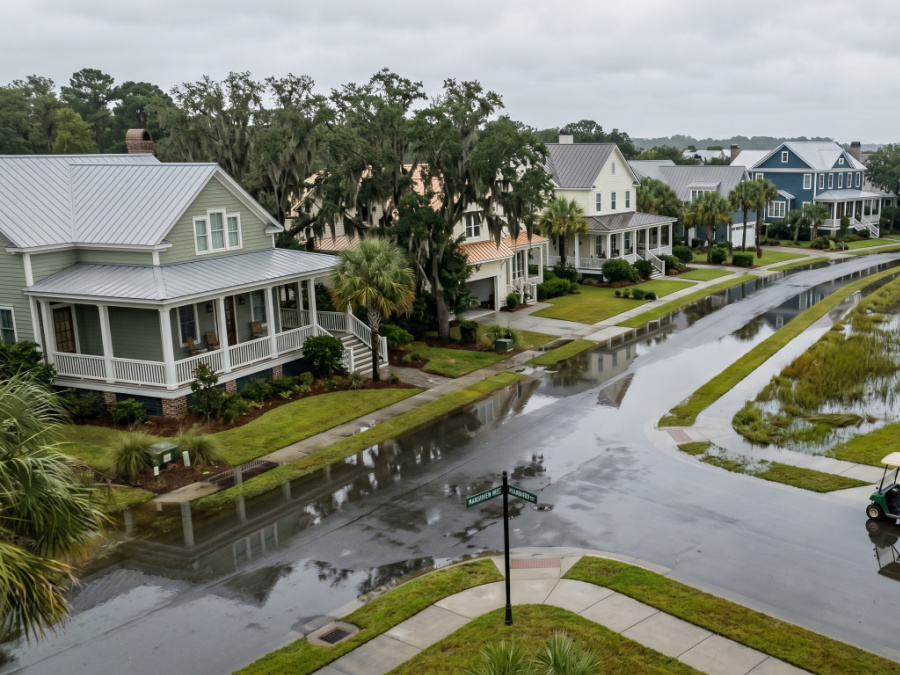
We have seen homes along May River Road and near Okatie Highway that fall outside high risk zones still deal with water during heavy rain events. It does not take a major hurricane to create a problem.
A combination of sustained rain, high tide, and limited drainage can be enough to push water into areas that are technically outside mapped flood zones. Bluffton’s terrain is flat, and with marsh systems and tidal creeks running throughout the area, water tends to move where it can go rather than where a map says it should stop.
Where Homeowners Get Caught Off Guard
One of the most common assumptions we hear is that if flood insurance was not required at closing, it probably is not necessary. That is where many homeowners get exposed without realizing it. A standard homeowners policy does not cover flood damage, which means any water that enters the home from rising ground water, overflow, or storm surge is excluded. Once it is classified as flood, there is no fallback coverage.
We have walked through policies with homeowners near Bluffton Parkway and toward Beaufort who were surprised to learn that their coverage would not respond in that situation.
They assumed water damage was water damage, but insurance draws a very clear line. When that line is crossed, repairs come out of pocket, and that can add up quickly. Flooring, drywall, cabinetry, and electrical systems are all vulnerable even in a smaller event.
Why Flood Insurance Is Often More Affordable Than You Think
For homeowners outside higher risk zones, flood insurance is often far more affordable than expected. Because the property is rated as lower risk, premiums tend to be significantly lower than homes closer to the marsh or along the Intracoastal.
In many cases, it ends up being one of the least expensive policies a homeowner carries, which is why it is often described as simple protection rather than a major expense.
When you compare that cost to what it takes to repair even a few inches of water inside a home, the value becomes clear. In Bluffton, that damage often includes more than just the interior. Many homes have garages that store golf carts, tools, and equipment, and those areas are often the first place water shows up.
Outdoor living spaces, covered patios, and first floor layouts also increase the amount of exposure compared to homes built further inland. It is not about expecting a flood every year. It is about protecting against the one time it does happen.
The Reality of Living in the Lowcountry
Bluffton is shaped by water. The May River, surrounding marshes, and tidal patterns all influence how and where water moves during storms and heavy rain. Add in ongoing development in areas like Buckwalter and New Riverside, and drainage patterns continue to change over time.
Roads like Highway 278 and Spanish Wells Road have both seen how quickly water can accumulate when systems are pushed beyond capacity.
Even neighborhoods that feel elevated compared to surrounding areas are not immune. Water does not drain quickly here, and when it builds up, it looks for the lowest available path. That is why local experience matters so much.
On paper, a property may appear low risk, but when you have seen how water actually behaves across Bluffton, you start to understand the difference between a mapped designation and real world conditions.
How We Approach This at Coastal Haven Insurance
We do not treat flood insurance as a simple yes or no decision based on a map. We look at how your property actually sits in relation to elevation, drainage, nearby water systems, and surrounding development.
That gives a much clearer picture of your exposure than relying on a zone classification alone. Every home is different, even within the same neighborhood, and those differences matter when it comes to coverage.
As an independent agency, we are not tied to one insurance company. That allows us to compare multiple options and find a policy that fits your situation rather than forcing you into a single solution. More importantly, we stay involved over time. As Bluffton grows and FEMA maps continue to evolve, we review coverage with our clients to make sure it still lines up with what is happening on the ground.
A Simple Way to Think About It
If you live in Bluffton and you are asking whether you need flood insurance, the honest answer is that you may not be required to carry it today. But requirement and risk are not the same thing, especially in a coastal environment where conditions can change.
The better question is whether it makes sense to leave your home exposed to a type of damage that is both common here and not covered by your standard policy.
For many homeowners, adding flood insurance is one of the simplest ways to close that gap. It is not about overreacting. It is about making a measured decision based on where you live and how water behaves in this area.
Final Thought
We have seen too many situations where homeowners assumed they were covered until they found out they were not. Once water is inside the home, there is no way to go back and adjust the decision after the fact. That is what makes this conversation worth having before there is ever a problem.
If you are not completely sure what your current policy does and does not cover, or if no one has walked you through your actual exposure here in Bluffton, it is worth taking a closer look. No pressure and no rush. Just a clear understanding of where you stand and whether adding that extra layer of protection makes sense for your home.

Coastal Haven Insurance Partners is an independent, locally owned insurance agency located in Bluffton, SC (40 Pennington Dr Suite E). Led by partners Coley Davis, Travers Davis, and William Voelkel, the firm brings over 30 years of combined insurance and leadership experience to the South Carolina Lowcountry. The team specializes in tailored homeowners, flood, windstorm, auto, and commercial insurance. They share straightforward guidance to help coastal residents and business owners protect their assets with confidence.