
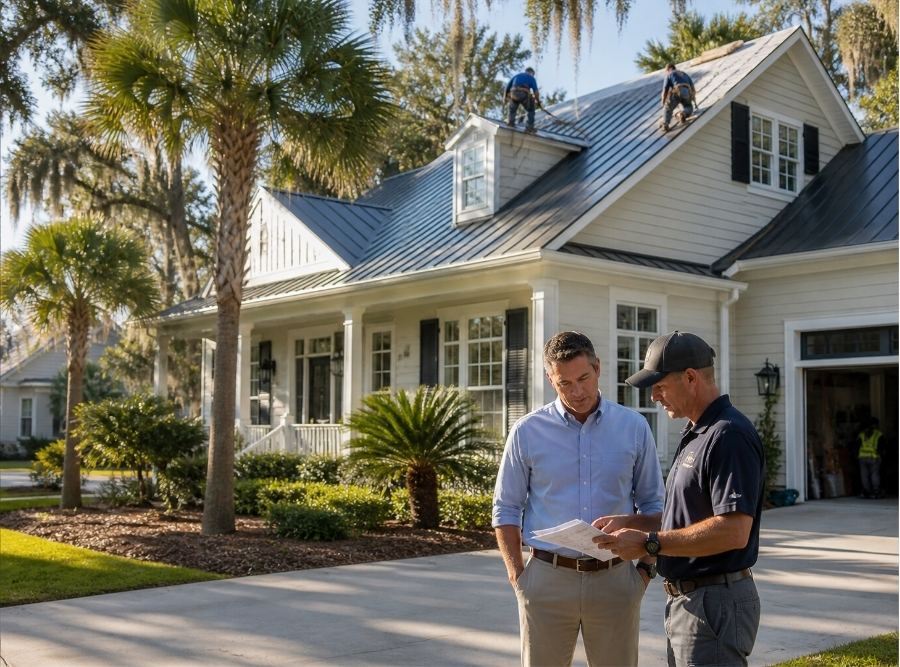
Will a new roof lower my homeowners insurance in Bluffton SC?
Quick Answer:
Yes, a new roof can lower your homeowners insurance premium in Bluffton, but the savings depend on the type of roof, how it’s installed, and which insurance company you’re with. A newer roof reduces risk and can qualify you for better pricing or more carrier options, but it does not guarantee a large or immediate discount. In many cases, the biggest benefit is improved eligibility and long-term cost control rather than dramatic short-term savings.
A lot of homeowners in Bluffton start asking this question when their premium increases or when an insurance company begins focusing on their roof during renewal. Sometimes it comes up after an inspection, sometimes after a quote comes back higher than expected, and sometimes after hearing that a neighbor replaced their roof and “got a better rate.”
Most homeowners go into this expecting a clear trade—replace the roof, lower the insurance. In reality, the outcome depends on several factors that are not obvious until you look at how insurers actually evaluate risk in Bluffton.
Why Insurance Companies Care So Much About Your Roof
In Bluffton, your roof is one of the most important parts of how your home is evaluated from an insurance standpoint. It is your home’s first line of defense against wind, heavy rain, humidity, and storm-driven damage. When a hurricane or strong summer storm moves through the Lowcountry, the roof is often where claims begin.
Because of that, insurance companies place significant weight on roof age, condition, and construction. A roof that is 15 to 20 years old is viewed very differently than one installed within the last few years, even if it appears to be holding up. In neighborhoods like Rose Hill, Pinecrest, or parts of Sun City, many homes are reaching that age range, which is why homeowners are seeing more questions and tighter underwriting around roof condition.
What most homeowners don’t see is that carriers are not just reacting to individual homes—they are reacting to regional claim patterns. In coastal South Carolina, repeated storm activity and roof-related losses have made older roofs a higher-risk category. That drives both pricing and eligibility.
The Biggest Misconception About New Roof Savings
The most common belief is that a new roof automatically leads to a large premium reduction. While a new roof can help, it is not a simple one-to-one exchange where you install a roof and immediately see a dramatic drop in cost.
In many cases, the savings are more subtle. A newer roof may qualify for a mitigation credit, improve how your home is rated, or open access to carriers that were not available before. But the amount of savings varies widely depending on the insurance company, the materials used, and how the roof was installed.
We’ve seen both sides, homeowners who expected major savings and didn’t see them, and others who unlocked better coverage options simply because the roof allowed access to a different market. The difference is not just the roof itself, it is how the entire policy is structured around it.
What Actually Changes When You Install a New Roof
When a new roof is installed, several things happen from an insurance perspective. The home becomes less likely to experience a claim related to wind or water intrusion, which improves its risk profile. That change can influence both pricing and eligibility, but it does not operate in isolation.
What often surprises homeowners is that insurance pricing doesn’t adjust in a straight line. A new roof improves your risk profile, but your premium is still influenced by broader coastal factors, including storm exposure, carrier appetite, and regional loss trends. That’s why the same roof replacement can produce different results depending on timing and insurer.
This is where roof age insurance requirements in South Carolina and potential Bluffton homeowners insurance roof discounts begin to come into play. Some carriers place more emphasis on age thresholds, while others focus more heavily on construction details and mitigation features.
A Real-World Scenario in Bluffton
We recently worked with a homeowner in the Buckwalter area who had seen steady premium increases over several years. The roof was nearing the end of its life, and fewer carriers were willing to offer competitive options. The homeowner replaced the roof expecting a significant immediate discount.
What actually happened was more important. The new roof allowed access to additional carriers that had previously declined the risk. By restructuring the policy with a more competitive company, the overall premium improved, but more importantly, the coverage became more stable moving forward. The value wasn’t just the discount, it was regaining control over the policy.
When the Conversation Isn’t About Savings Anymore
In some cases, the conversation shifts entirely. It stops being about whether a new roof will lower your premium and becomes about whether you can keep your current coverage at all.
We’ve seen situations where homeowners were given a limited window to replace a roof before renewal, not because the roof had failed, but because it crossed an underwriting threshold. At that point, the decision is no longer optional, and the timeline is no longer flexible.
The difference is whether you’re making that decision on your terms or reacting to a deadline set by your insurance company.
Why Waiting Too Long Can Cost More
Many homeowners delay roof replacement because of the upfront cost, especially if the roof is still functioning. The challenge is that insurance companies do not always wait until a roof fails to act. As roofs age, carriers may increase premiums, restrict coverage, or reduce available options.
In Bluffton, where storm exposure is constant, waiting too long can narrow your choices significantly. Once fewer carriers are willing to write the home, pricing becomes less flexible and coverage terms become less favorable.
Timing also plays a role. Updating your roof before it becomes an underwriting issue typically gives you more flexibility in choosing carriers and structuring coverage. Waiting until it becomes a requirement often limits those options.
The Independent Advantage in Evaluating Roof Impact
Not all insurance companies treat new roofs the same way. Some place more value on mitigation features, while others focus more heavily on overall coastal exposure. That is why the impact of a new roof can vary depending on which carrier is evaluating it.
As an independent agency, Coastal Haven Insurance looks at how your specific home fits within the current market. We evaluate roof age, materials, installation quality, and how different carriers price those factors. Instead of assuming a new roof will create savings, we identify where it actually creates opportunity.
Most homeowners only revisit their insurance when something forces the conversation. But with something as significant as a roof replacement, it makes sense to review the policy proactively so the investment in the home is reflected in the coverage.
What a New Roof Really Changes for Your Insurance
A new roof can absolutely help lower your homeowners insurance premium in Bluffton, but the real value goes beyond the immediate number on your policy. It improves how your home is viewed by insurers, expands your options in the market, and reduces long-term risk tied to coastal conditions.
In a place where wind, rain, humidity, and storm exposure are part of everyday life, the roof is not just another component of the home, it is one of the primary drivers of both protection and insurability.
If you are considering a roof replacement or have recently completed one, it is worth taking a closer look at how that change impacts your insurance. The difference between assuming it helps and understanding exactly how it affects your policy is where most homeowners find the real benefit.

Coastal Haven Insurance Partners is an independent, locally owned insurance agency located in Bluffton, SC (40 Pennington Dr Suite E). Led by partners Coley Davis, Travers Davis, and William Voelkel, the firm brings over 30 years of combined insurance and leadership experience to the South Carolina Lowcountry. The team specializes in tailored homeowners, flood, windstorm, auto, and commercial insurance. They share straightforward guidance to help coastal residents and business owners protect their assets with confidence.