
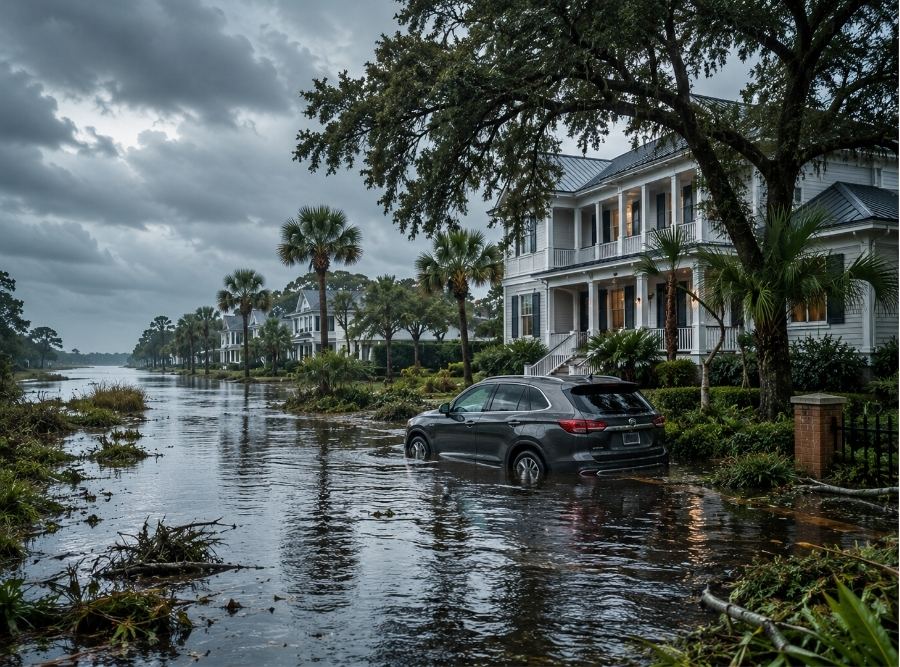
Does Liability or Comprehensive Insurance Cover Flood Damage in Bluffton?
Quick Answer:
Comprehensive car insurance generally covers hurricane and flood damage to your vehicle in Bluffton, including damage from storm surge, fallen trees, wind-blown debris, and water intrusion. Liability-only insurance does not cover damage to your own car because it is designed to pay for injuries or property damage you cause to other people. Coverage still depends on your deductible, exclusions, policy limits, and the circumstances of the loss.
Comprehensive vs. Liability Coverage for Storm Damage
Whether car insurance covers hurricane or flood damage depends on the type of coverage you had before the storm. Comprehensive coverage is the part of an auto insurance policy that typically applies to non-collision losses such as flooding, storm surge, fallen trees, hail, fire, theft, vandalism, and wind-blown debris.
Liability coverage serves a different purpose. It helps pay for injuries or property damage you cause to someone else, but it does not pay to repair or replace your own vehicle after a hurricane, flood, or other weather event. Collision coverage generally applies when your vehicle hits another vehicle or object, so it does not normally replace comprehensive protection for storm-related losses.
Drivers also sometimes assume “full coverage” means every type of loss will be paid without limits or out-of-pocket costs. However, full coverage is not a specific policy. It commonly refers to a combination of liability, collision, and comprehensive insurance, each with its own deductible, limits, exclusions, and conditions.
Why Flood Damage Can Be Worse Than It Looks
Understanding the coverage distinction is only the first step. Flood damage can be difficult to recognize because a vehicle may still start and appear usable while moisture is spreading through electrical and safety systems beneath the surface.
Modern vehicles contain wiring, sensors, airbag modules, cameras, control units, and electrical connections throughout the lower interior, beneath seats, inside floor channels, and along the chassis. Floodwater does not need to reach the dashboard to damage these components. Even relatively shallow water may lead to corrosion, electrical instability, battery problems, mold, warning lights, or inconsistent braking and steering.
Problems may not appear until days or weeks after the storm. A vehicle may run normally at first, only to develop flickering dashboard lights, sensor failures, repeated battery drainage, mold odors, or intermittent electrical faults later. That delayed progression is why drivers should not assume a vehicle is safe simply because it starts after the water recedes.
Saltwater exposure can be especially destructive in coastal South Carolina. Salt accelerates corrosion and may continue damaging wiring harnesses, connectors, grounding systems, airbag sensors, control modules, and structural components long after visible moisture has disappeared. Because the long-term effects may be difficult to repair reliably, significant saltwater intrusion is more likely to result in a total-loss decision.
Why Bluffton Vehicles Face Greater Storm Risk
Flood-related vehicle damage in Bluffton is not limited to homes directly beside the May River or other waterfront areas. Tropical rainfall can overwhelm retention ponds, neighborhood drainage systems, intersections, parking lots, and low-lying roads throughout the region.
Areas near Highway 278, Bluffton Parkway, Burnt Church Road, Buckwalter Parkway, and New Riverside may experience standing water or drainage problems during severe weather. Older communities near Old Town Bluffton and marsh-adjacent corridors may face tidal flooding, fallen trees, and wind damage at the same time.
Rapid development can also change drainage patterns as additional pavement and construction increase runoff pressure. A neighborhood that is not located in an obvious coastal flood zone may still experience water accumulation when heavy rainfall exceeds the capacity of nearby ponds, ditches, or storm drains.
Seasonal residents and second-home owners face another challenge. A vehicle left parked during an evacuation may sit in standing water for hours or days before the damage is discovered. During that time, moisture, corrosion, and mold can continue spreading even after the surrounding water has receded.
What to Do After Your Vehicle Floods
After a hurricane or flood, personal safety should come first. Do not enter moving or contaminated water to reach a vehicle, and do not repeatedly try to start a car that may have taken on water. Starting a flooded engine can worsen mechanical damage, while electrical systems may behave unpredictably after water exposure.
Once the area is safe, photograph and record the vehicle’s condition before making major changes. Capture the exterior, interior, visible water lines, debris, standing water, and surrounding area. Save towing receipts, repair estimates, claim numbers, and all communications with the insurance company.
Contact your insurer promptly and ask what inspection, documentation, or towing procedures are required. Avoid extensive cleanup before the original condition has been documented, although reasonable steps to prevent additional damage may still be appropriate. A professional inspection is also important because a technician may identify contamination or electrical problems that are not visible during a basic exterior review.
Large regional storms can create delays because adjusters, repair shops, towing companies, rental providers, and parts suppliers may all become overwhelmed at the same time. Reporting the loss promptly and maintaining organized records may help prevent avoidable complications, even when broader claim volume slows the process.
Deductibles, Total Losses, and Vehicle Value
If hurricane or flood damage is severe, the insurer will evaluate the extent of the water intrusion, corrosion, mechanical damage, electrical contamination, repair costs, and long-term reliability concerns. The vehicle may be repaired or declared a total loss.
A total-loss settlement is generally based on the vehicle’s actual cash value immediately before the damage occurred. That amount may not equal the original purchase price, the remaining loan balance, or the cost of buying a comparable replacement in the current market.
This can create a financial gap for drivers who owe more on the vehicle than it is worth. Gap coverage may help in certain situations, depending on how the vehicle was financed and the terms of the coverage.
Comprehensive claims also usually include a deductible. For example, if a covered repair costs $4,000 and the comprehensive deductible is $500, the policyholder would generally be responsible for the first $500 before the insurer pays the remaining covered amount. The exact payment will depend on the policy and the insurer’s claim evaluation.
Reviewing the deductible before hurricane season is important because a lower premium may come with a higher out-of-pocket cost after a loss. Drivers should consider whether they could comfortably pay the deductible while also managing other storm-related expenses.
Review Your Coverage Before Hurricane Season
The hardest time to discover a coverage gap is after a storm has already damaged the vehicle. Once a named storm is approaching the South Carolina coast, insurance companies may temporarily restrict new policies or changes that increase storm-related protection.
Bluffton drivers should review their policies before hurricane season and confirm whether comprehensive coverage is included, what deductible applies, and how the policy addresses flooding, fallen trees, debris, storm surge, and total losses. It is also worth comparing the vehicle’s current value with the cost of coverage and any remaining loan balance.
At Coastal Haven Insurance, we help drivers in Bluffton, Hilton Head Island, Okatie, Beaufort, and surrounding Lowcountry communities understand how their auto insurance may respond to local storm risks. A policy review can identify potential gaps before tropical weather develops and before water reaches the vehicle.
Comprehensive insurance may make the difference between a manageable claim and paying the entire cost of a storm-damaged vehicle yourself. The best time to understand that protection is long before the first hurricane warning appears.
Frequently Asked Questions About Flood-Damaged Vehicles
You may be able to add comprehensive coverage before a storm becomes an immediate threat. However, insurers may temporarily restrict new coverage or policy changes when a named storm approaches the coast. Comprehensive protection must already be active when the damage occurs for a related claim to be considered.

Coastal Haven Insurance Partners is an independent, locally owned insurance agency located in Bluffton, SC (40 Pennington Dr Suite E). Led by partners Coley Davis, Travers Davis, and William Voelkel, the firm brings over 30 years of combined insurance and leadership experience to the South Carolina Lowcountry. The team specializes in tailored homeowners, flood, windstorm, auto, and commercial insurance. They share straightforward guidance to help coastal residents and business owners protect their assets with confidence.